
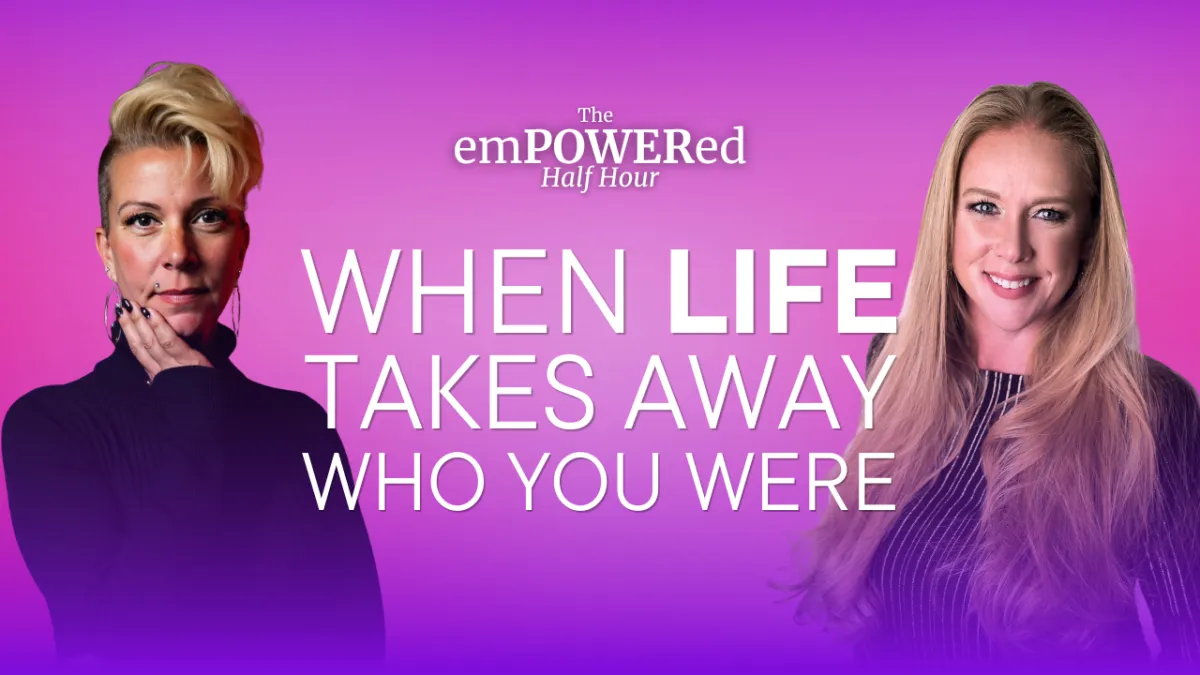
When Life Takes Away Who You Were
Amber Houghton spent 28 years building an identity around being strong.
Strong enough to survive a difficult childhood. Strong enough to make it in a male-dominated military career field. Strong enough to keep pushing through pain, pressure, and performance without slowing down.
Until one season of loss cracked everything open.
After retiring from the Air Force, going through a devastating divorce, and losing the identities she had built her entire life around, Amber found herself face-to-face with the question so many high performers avoid:
Who are you when the titles, roles, and achievements disappear?
This conversation goes into the cost of suppressing pain, living in survival mode, and the difficult but powerful process of rebuilding yourself from the inside out.
Amber also shares how her work with young athletes revealed something most adults still struggle with: tying self-worth to performance.
This conversation is about what happens when life takes away everything you thought made you who you are.
In this episode:
What happens when your entire identity is built around achievement and service
Why emotional pain eventually manifests physically in the body
The hidden cost of constantly trying to prove you are “strong enough”
How compartmentalizing emotions can quietly push high performers toward burnout
Why asking yourself “why” five times helps uncover the real root of your emotions
The difference between healthy growth and pushing yourself until you break
How athletes and high achievers tie their worth to performance from a young age
Quotes from this episode:
“We don't grow when we're comfortable.” – Amber Houghton
“Who are you if you're not a mom? Who are you if you're not a chief or an airman? Who are you if you're not a CEO?” – Amber Houghton
“There is a very fine line between pushing yourself enough to grow and be uncomfortable, to pushing yourself to where you're broken.” – Amber Houghton
“Each time I come out the other side, I am so much more aware of life and its preciousness, capabilities, and potentials.” – Becca Powers
“When we don't listen to our bodies' red flags, we push past them and everything gets impacted.” – Becca Powers
About Amber Houghton
Former Air Force Chief Master Sergeant turned Leadership and Performance Coach for athletes, coaches, and high performing teams.
She translates 28 years of leading under pressure in the United States Air Force into practical frameworks that build calm, confident leaders on and off the field. Pressure does not build character, it reveals it, and she teaches leaders how to perform through it.
After nearly three decades in uniform, she now helps athletes and coaches perform at their peak without losing themselves in the process by bringing structure, clarity, and composure to how they lead.
Her work blends military leadership experience with the emotional intelligence modern leaders need. Her frameworks are built from lived experience under extreme pressure and refined in real world environments with teams and athletes.
Connect with Ariane:
Instagram: https://www.instagram.com/amber.houghton.94/
Facebook: https://www.facebook.com/Amber.Leigh.Houghton/ and https://www.facebook.com/ElitePerformanceStrategies
Connect with Becca:
Website: https://www.beccapowers.com
Instagram: @beccapowers1313
LinkedIn: Becca Powers
Facebook: Becca Powers
Join the community:
The Dragonfly Effect on Facebook: https://www.facebook.com/share/g/1C4z83krsn/
Get the book:
A Return to Radiance: https://www.beccapowers.com/a-return-to-radiance
Book Becca to speak: https://www.beccapowers.com/keynotes
Free resource:
The High Performer's Path eBook: https://www.beccapowers.com/
🌟 Did you love this episode of The emPOWERed Half Hour Podcast? Sharing your thoughts can make a big impact!
💬 Leaving a review is simple:
Scroll down to the "Ratings & Reviews" section.
Tap "Write a Review" to share your thoughts and let others know what you loved about the show.
Your feedback helps us grow and continue delivering the content you love. Thank you for being part of our empowered community! 💖
Becca Powers: Welcome to another episode of the Empowered Half Hour, and I'm really happy today because I get to bring to you one of my friends, colleagues, and peers in the coaching and high performance industry. Amber Houghton. Amber, welcome to the show.
Amber Houghton: So excited to be here. Thank you for having me.
Becca Powers: I've been like counting down the days until I gotta interview you. But let me tell the audience a little bit about you. So Amber, she's gonna tell you more about her backstory, but currently Amber is a leadership expert and specializes in high performance strategy, and she does so because she has quite the impressive background and has been one to reinvent herself. So as we talk about Amber and the things that she's gone through, I hope that it inspires you in your journey just to keep growing and keep evolving. And we spoke about in our pre, our pre-interview pivoting, so you might hear the word.
Lemme ask the first question.
Amber Houghton: Okay.
Becca Powers: So today you're showing up as a leadership expert, high performance strategist. I know you've worked with, see like, you know, football teams, so athletes, retirees from the military, two. But I would love to turn it to you and you know, can you tell me and the audience a little bit about your background and why you're passionate about doing what you're doing today?
Built Through Challenge
Amber Houghton: Absolutely. So, wow. I was a very troubled teenager and I had some challenges with authority and I eventually ended up,
Becca Powers: that is not surprising. I mean, I did too, but I'm like, okay,
Amber Houghton: yes. Yep. So I started off on my own at 15 and a half. My mom was, we were not compatible at that age. I was not compatible with her. She was not compatible with me. So I started, I just moved out on my own, had a really rough go of it. Dad wasn't around to be able to help me. That was his choice. And you know, it taught me a lot of things. I'm not bitter, I'm not angry. I'm very actually very grateful and thankful for that, this upbringing, these challenges, or else I wouldn't be who I'm today.
But around the time that I was 17 and fixing to graduate from high school, my brother told me about the Air Force and he was like, Amber, it's great. They feed you, they clothe you, they provide a roof over your head and they pay you money. And I said, that sounds glorious. As I'm bouncing from home to home trying to figure out my life, lemme go talk to a recruiter.
And so that was the beginning for me of a 20, 28 year journey within the Air Force where I started off at the very basic L am basic. And I worked my way through all the way to chief, master sergeant it, which is an E nine, and the top 1% in the Air Force, on the enlisted side in a very heavily male dominated career field.
Becca Powers: I was just gonna say, yes,
Amber Houghton: built bombs and missiles and anything that went boom, more often than not, I was the only female. That was also had its challenges and it also had its bonuses, right? I think it's a has full sides of the coin there.
From there, I retired in 2023 and I made the decision to be more present in my kids' lives. I had missed a lot. I have three children. One's about to turn 22 in Texas. The other one is 18, graduating this year. And then I have a 13-year-old son who's about to be 14.
And so this, the last two and a half years I thought we're going to be very easy, easy breezy, right? Retire. I'm gonna live the good life. No, that's not what happened.
Becca Powers: It
Amber Houghton: typically
Becca Powers: isn't.
Amber Houghton: Yes. Right. More challenges from losing, and I talk a lot about identity and I lost all four identities in one fell swoop, and so I retired from the military. I lost the identity that I had built. I spent 28 years building my life around as an airman, as a chief, as a leader, a servant leader to, I lost my identity as a wife. We went through a very terrible divorce, and during that timeframe I lost the identity of being a mom and my children. Divorce is terrible, right? Yes. And we go through a lot of things and one parent can sometimes take the brunt of that.
And so for me, all of the things that matter, especially the mom piece, all of the things that matter to me, just kind of exploded. It was a really big hit.
And but again, thankful for this. And I know that sounds weird and wrong, but I wouldn't have built myself or rebuilt myself the way I am today if I hadn't had those experiences. And I really believe in sacred. There's sacredness and suffering. We don't grow when we're comfortable. So that's through that.
And my son's journey through football, he's been playing since he was five, brought me into the coaching world. And so I have always made myself available to help anybody who needed a voice who wanted somebody to listen to them.
But for me, standing on the sidelines and watching young kids have these high performance meltdowns because the coaches are yelling at 'em, the parents are yelling at 'em, the fans are yelling at 'em, the referees yelling at 'em, you know, and I was like, oh my gosh, I know this. I know this struggle right here. They're yelling at you to be a leader, but nobody's ever taught you how to be a leader.
Becca Powers: No. You how to.
Amber Houghton: Yes. And so that's how I entered into the coaching world.
I just started pulling kids aside who I saw were struggling and just having a conversation with them and then helping them reset and get back in the game. And from that, it just grew into now where I am a leadership consultant for the local high school, I have athletes that I spend a lot of time with teaching them. From this younger age, Hey, this is what leadership looks like, this is how you lead yourself, you know?
And the first step of that is finding out what your why is. Why do you love football? And it can't be just 'cause I love the game.
So it's been very eye-opening and rewarding. And so from that point, now I'm starting to through social media and this amazing healing journey.
Good. By the way. Social media expert. This has been such a healing journey for me as I work through a lot of the stuff that I put into Pandora's Box over the last, I don't know, 40 years.
There are days where my post is late and I feel bad, but I'm also in tears and I'm crying and I'm trying to figure out like, okay, this is the message that I'm trying to send without being completely off my rocker rails, just to kind of share the journey and everything that's going through.
Know Amber's mind at the time.
Becca Powers: no. The vulnerability that you share and the leadership lens that you put on it is just really incredible. I don't get to, I don't comment all the time, but I'm a surfer and I
Amber Houghton: I love it.
Becca Powers: Yeah. I'm like, but I see you and I read them.
Becca Powers: So I was gonna say, I'm like, there's so much in that opening that I wanna unpack. We could start off with just like a small, and then I really wanna go and go into the career and you mentioned being, you know, a woman in a male dominated field.
Like there's so many like caveats that we can go down. But you know, I think that the first one that really hit me as I was listening to your story was just that you ended up on your own when you were young, right? And that you did some couch surfing and stuff like that. And I think that if we're being really, you're probably not the only one, you know, especially we're in the Gen X ish era. Parenting was different when we were younger.
And I think that as I coach people, I still hear a lot of people having resentment to their parents and the way that they were grown up and whether they're high performing or not. I don't think that a lot of people understand that that resentment is blocking them moving forward.
And so just from that, I would love you to maybe share like an aha or something that you learned that helped you like let it go, and then what it gave you as a result.
Amber Houghton: So just a little bit of context. My mom and dad got divorced when I was young. He was an abusive alcoholic. And there was a time period where my mom kidnapped us and took us, and then he found us and brought us back.
So I'd been surfing, home surfing. My dad wasn't sure from my perspective what to do with me because I was a girl. He knew how to relate to the boys. I have two brothers, but I think I threw him for a loop 'cause I was the girl.
And so I went from female relative to female relative to female relative until I found my mom when I was 15. And I said, Hey, I just want a place to lay head.
And so for that, you know, comes a lot, a lot of, gosh, abandonment, rejection, anger, grief, loneliness. What I wish I could have, have that I didn't have, that I saw my friends have, right? I mean, there's so much in this. A lot.
Becca Powers: Yeah.
Amber Houghton: This journey here and you know, I'm gonna, I needed help unpacking all of this. And I tried the traditional therapist and the counseling and those things didn't quite pan out the way that I had hoped. It was just very clinical for me.
And I just wanted to go deeper and I really wanted to understand, and it was through some friends that do a different type of coaching that helped me be able to start to dip my toe into that mess. That's what it was, you know, it was just a hot mess.
Becca Powers: Yeah. I had to go clean up mine too.
Amber Houghton: So, you know, again, as you open on, and I refer to it as Pandora’s box, and we, you know, we have to do these, we compartmentalize, and then in the military we are really taught to compartmentalize. So everything goes into that box. And so here I am just, you know, pulling things out, going, oh, what is this that happened?
Oh
Becca Powers: God, there's another one.
Amber Houghton: Yeah. And it happens wherever, you know, Lowe’s and somebody texts you and Lowe’s. Next thing you know, you're sitting on the sofa, you know, the, the patio furniture crying because she just pulled a memory out for you. You know? And that's no kidding that happened. So for me, it was being, being able to be coached in a manner that helped me pull myself out of my pain. To be more of an observer and say, okay, listen, like yes, all of these things happened not to me, but for me. Right.
Becca Powers: I love that. Just got the goosebumps. That's really important to share. You know?
Amber Houghton: It really is. And when you, when you're able to come to that aha moment, that's that aha moment for me. I was like, these things didn't happen to me. They happened for me. And if they didn't happen, no matter how terrible they were, and, and I'm not trying to minimize anybody's pain or my own, but if we just take that second, that intentional deep dive inside and say, okay, let's, what is the goodness that came out of this? What came here from this situation? I mean, like now I am the calm and the chaos, right? The world could be burning down around me, and I know what to do. I'm calm, I'm cool, I'm collected, and I know how to get us where we need to go. If I hadn't been through some of the situations and scenarios in my life, I don't think that I would be in that situation now, I wouldn't be prepared for that. If I had rebuilt myself so many times as a youngster and a young woman, I don't think that at the age of, you know, 47, when I lost everything, I would be able to rebuild myself. And so that moment, that aha moment is being able to step back and say, what is happening for me? Not what is happening to me.
Becca Powers: That's amazing. That's amazing. And, um, I think that it's funny recently I've had a couple conversations around dark nights of the soul and them lasting a year or two or three years before the final, you know, dawn breaks and stuff like that. But on the other side of it, when you face it and you go into these seasons that are unexpected and you don't know what the hell to do, but then like you said, you've got all these learnings and at 47, honestly, like I'm coming out of a dark night of the soul too, and I wasn't expecting to go through it. I had no idea. You know, I went through one 10 years ago and I was hoping that was gonna be my last one, right?
Amber Houghton: This, this? No, we, we need to do this again. Okay. Really? Come on,
Becca Powers: man. But each time I come out the other side, I am so much more aware of life and its preciousness and capabilities and the potentials. And it's weird that on the other side there's an expansion waiting for you. Yes. And I don't know if you've witnessed the same thing, but that's what I've witnessed through my various seasons of chaos.
Amber Houghton: No, I have, and I've, and you know, the universe, the source, God, you know, whatever resonates with you has a funny way as soon as you get comfortable and you're like, I feel like I have my shit together, we're gonna bring this situation or this scenario to you to see if you really do have it together, or if we still need to shed some light on some places that you need to work on. So, yeah, it's an ever-ending spiral of learning and healing. And I don't think that we're ever 100% healed. I think that it just, those wounds that we have, um, or experiences that we went through, I think there's layers and each layer, you know, like leveling up in a video game. I got through the first level. I rock, oh, this one's gonna be harder. Oh, this one's gonna be harder. But it has all the same premise underneath it of whatever you have that's going on shadow wise or that you need to shine a light on within you. So it's definitely a journey.
Identity, Leadership, and Finding Voice
Becca Powers: That that it is. And I love that you tie your work to identity. And I wanna go back to your career in the Air Force, so you know. Differently, but I've spent a 22 year sales career in technology. So a, being a saleswoman instead of a sales man and two being in technology, um, has left me in the minority group as well. And I am very thankful for my own experience because it taught me resilience. Capacity not to take things personally. I have a pretty tough skin and there's so many, like little, so many lessons and takeaways that I've gotten from my career. But I'd be really interested to hear, you know, maybe some of your experiences or some of your learnings, like what did being in that environment make aware for you or make possible
Amber Houghton: Primarily. Yeah. Um, so. Aware for me would be using my voice, not just, I can use my voice for others all day long. I have no, I will fall on that sword for you all the time. When it comes to me, I will suffer in silence 100%. And so it was a long journey, you know, throughout. But towards the end of the last 10 years of my career, I started speaking up for me and saying, Hey, no, you don't get to talk to me like that. Hey, that's not acceptable. Hey, let's, you know, shift gears here and talk about what just happened. So it provided me the opportunity to find my voice again after not having it for so long. And, um, again, my upbringing and throughout my life and not having that ability to say what I needed to say. So that's probably the biggest one is helping me find my own voice for me again.
It also taught me boundaries. And when I say boundaries, I mean I would martyr myself. I will sacrifice myself. At points in my career, I would sacrifice my priorities so they would shift. And so it taught me, hey, these are my priorities. These are my boundaries and I need to enforce them. And it looks like I would push myself so hard because I didn't wanna be the weak female. I didn't wanna be, oh, see, I told you she's a girl. So I would push my body to the max. I'd land myself in the hospital with a kidney infection, and I still wouldn't slow down. And so I've had 15 surgeries, minor heart surgery, a hip replacement, torn biceps, shoulder, knees, feet.
Becca Powers: damn.
Amber Houghton: So I had no boundary with this. So if you were on my team and you were like, Hey, go pick that up, and it was 150 pounds, I'd be like, okay, I'll go pick it up.
Becca Powers: Do it.
Amber Houghton: Yeah, exactly. Like I'm not gonna be that weak link in the chain mail. Right? Like, I'm not gonna do that. And so I sacrificed my body in order to be able to do that.
Becca Powers: Yeah. And that sounds a lot like boundary work and action.
Amber Houghton: Yeah, it does. And as I got older going, okay, my body is amazing, right? It has gotten me through. And if we sit there and think about what our bodies do for us daily, what we ask our bodies to do for us, it is incredible.
Body, Burnout, and Breaking Points
Amber Houghton: And if you, just for a second pause and think about everything you've asked your body to do and it has endlessly done it for you until it gets to a point where you know it can't because you're not listening. And that was my lesson too, is like, hey, I wasn't listening to my body through all those years and so for the last three years I have just spent rebuilding my body. And I'm like, alright, this is all about you and reconnecting with you and helping you recover from everything I put you through.
Becca Powers: That's a beautiful message though, because when we don't listen to our bodies' red flags, we push past them and then it impacts our physical body, emotional body, spiritual body, mental body. Everything gets impacted.
And there is something to pushing yourself to a certain degree because then you figure out what you're made of. But then there's that extra point where we start to break down.
Becca Powers: Yeah. And that shit sucks. Like I pushed myself to autoimmune disease and it took me two years to recover.
Amber Houghton: And a big part of that too is the emotional and mental piece. When we hold onto this stuff and we continue to suppress it and put it in Pandora’s box, it can take on a life of its own.
Amber Houghton: have any patience with, you know, things that I would normally would not bother me and I had to sit there and be like, okay, what is going on? Like, what is going on inside of me right now?
And that box that I had stuffed everything in over the last 40 some odd years, took a life of its own and was threatening to break open and frag everyone around me that I love. And that was a big wake up call for me. And it was manifesting in my body too, right? Migraines after migraine.
Becca Powers: Yes,
Amber Houghton: the issue with my hips, my back, I was getting my nerves burned off and my back every year. I mean, I was just like, what is, I was overweight, I was unhappy. I mean, everything just feeds into it. And so if we're in this position, like being able to sit down and get logical about it and say, all right, I love whiteboards, so I'm a whiteboard nerd, and anytime that I have something going on, I write it up on my whiteboard and I'm like, I feel upset today. Why? Right. Like, what was it? I asked myself that question, why five times? And I, um, and it's funny because it used to irritate my airmen and it used to irritate the folks that I worked with because they're like, why do you always ask why five times?
And I said, because that's what it takes to get to the root. Like, I need to understand what's underneath everything. So if I'm angry, why am I angry? Well, I'm angry because I felt disappointment. Well, why did I feel disappointment? Well, I felt disappointment because I didn't live up to somebody's expectations. Well, why did I have those expectations in the first place? Right? And so we start digging down and this is something you can do yourself. You know, granted, you gotta be honest with yourself. We gotta be able to look in the mirror. But it's a great exercise for me to work through whatever it is that I have that's surfaced in that moment.
Identity, Who You Are Without the Labels
Becca Powers: Yeah, I love that. I, uh, why five times? You hear that guys? Ask yourself why five times? That's awesome. I do ask why, but I don't think I've done the five times path. So I'm gonna take that as a little experiment and give it a whirl and, all right. So, but I do wanna loop back around to, um, another focus, like one of your main focuses in your coaching is identity and, uh. You had mentioned when in the pre-interview that you know one of your themes is in programs is reset and rise and that it's around identity. So identity, Ooh God. That's such, such important work to do because when we identify with something, we keep ourselves in a bucket and that bucket sometimes when it's supporting us in a good way, it feels safe and things like that. But then when we can no longer identify with that, then we feel lost out of control and, um, you know, potentially could go into spirals. So I'm really curious of, I think it's dope that you focus on identity, but I wanna kind of hear your perspective on your work and why you like it and what you do and all that jazz.
Amber Houghton: so identity is such a big thing and I had to go through it deeply, right? Um, before I could, I always talked about it like, who are you? If you're not a mom, who are you? If you're not a chief or an airman, who are you? If you're not a CEO, who are you if you're not an athlete? Right? Like, what makes up you?
And I found I had a hard time answering that and articulating for myself. And then I was like, that's weird. I thought I knew myself pretty well. Like I'm, I do a lot of self-reflection and I do a lot of self-improvement and I read a lot and listen to podcasts, so, you know, so when I couldn't answer those questions for myself, I was like, what was that?
So as I started just kind of asking people around me in my circle, you know, like, well, who are you if you're not a mom? Which was the biggest one. And man, I mean, the response was just like, I don't know. Who am I, you know, and then they're walking away going, who am I? You know? And I didn't mean to, but I inadvertently cracked something open and then I never followed through or never walked with them or, you know, I would check on them, but like, they'd be like, you know, you really messed me up with that question.
So as I just started walking through the military and being a leader, like being a servant leader was super important to me, and I loved taking care of my people, even if I wasn't the leader for them, right? But having that conversation and saying, well, who are you if you're not that rank, or who are you if you're not the best bomb builder in the bomb dump? Like, what is all of this? What's underneath all of this? And I just became extremely curious about it within myself and within others. And then it just kind of cracked open from there. And it's, I think it's so important.
Becca Powers: You one third time. Yes,
Amber Houghton: but I think it's so important that we teach this work. Did you learn any of this work before you had been punched in the face by the universe?
Becca Powers: No. I had to teach myself when I went through like a dark night of the soul in my, I was like, I had to ask myself every damn question that ever existed. Pretty much just to like know who I was going to be at the end. Like, you know, you go through one of these experiences and you're like, I'm not this person and I don't wanna be this person. I know what I don't want, but what do I want? Who am I? You know, and so that's, discovery is pretty thrilling, but also scary.
Amber Houghton: so scary. Oh yeah. Nothing like jumping into the unknown. Right. And uncertainty. Yeah. Like, all right, I don't know where I'm going, but we're gonna do this. So it's, uh, but this work, I think that the impact we can have on each other is humans. Right. Just by simply helping each other figure out like, Hey, who are you without all of these things that you've built around you. You know, it's like I built this little home and then I built a moat, and then I built another wall, and like, you can't get in to see the real me because I built all these things around me, these identities that I've, I've built up through my personal experiences, like who are you? And all of that is taken away. Like what is at the core of you?
And I think it's so important for us to be able to learn that about ourselves and we don't teach it. So, okay, let's do it. I'm gonna try and I, you know, it just so happened to organically develop through young athletes and being able to, you know, hey, why? On the sidelines, being able to say, okay, breathe, get your central nervous system under control. Why are you upset? And the minute they can recognize the real reason why they're upset, and it typically for young athletes has to do, they don't feel good enough. Their performance with everything, their identities tied to performance. As soon as we can unlock that or bring awareness to that, man, they can go back out on the field and make these amazing game changing plays, and I love that for them because that's a life skill that they now have in their toolbox for the rest of their life.
Becca Powers: Goosebumps number four. That's awesome and it kind of leads me into our last question 'cause I just looked up and I realized we're at 30 minutes already, so it's maybe not as much of a question as it is a request for a statement, but I always like to end the podcast with an empowering message for the listeners. So what would you like to say to them?
Amber Houghton: Well, primarily. You are not alone. Whatever it is that you're going through, you are not alone. And even if you may not have a lot of humans around you, I would encourage you to go inwards because even again, if you don't have a lot of humans around you, I look at myself and I'm like, there's 48 versions of me that's with me right now. Right now, all of that love, experience, support, that is all within me for me. So you're never alone. And it's a choice. It's always a choice. And I really hope that you choose to not be alone.